How many rolls do I need? The definitive wallpaper calculator guide
Measure twice, order once. We walk you through the exact formula — accounting for pattern repeat, door and window cutouts, and when to order extra.
Ordering too few rolls is one of the most common — and most expensive — mistakes in home decorating. Dye lots vary between print runs, which means a roll ordered six weeks later may not match the rolls you've already hung. The only insurance is to order enough the first time.
Here's the exact process we use. It takes about ten minutes and a tape measure.
Step 1: Measure your walls
Measure the width of each wall you intend to paper, then add them together to get the total perimeter. Measure the height from skirting board to ceiling (or to the cornice if you're stopping there).
Example: a room with four walls measuring 3.6m, 4.2m, 3.6m, and 4.2m has a total perimeter of 15.6m. Ceiling height is 2.5m.
Step 2: Understand pattern repeat
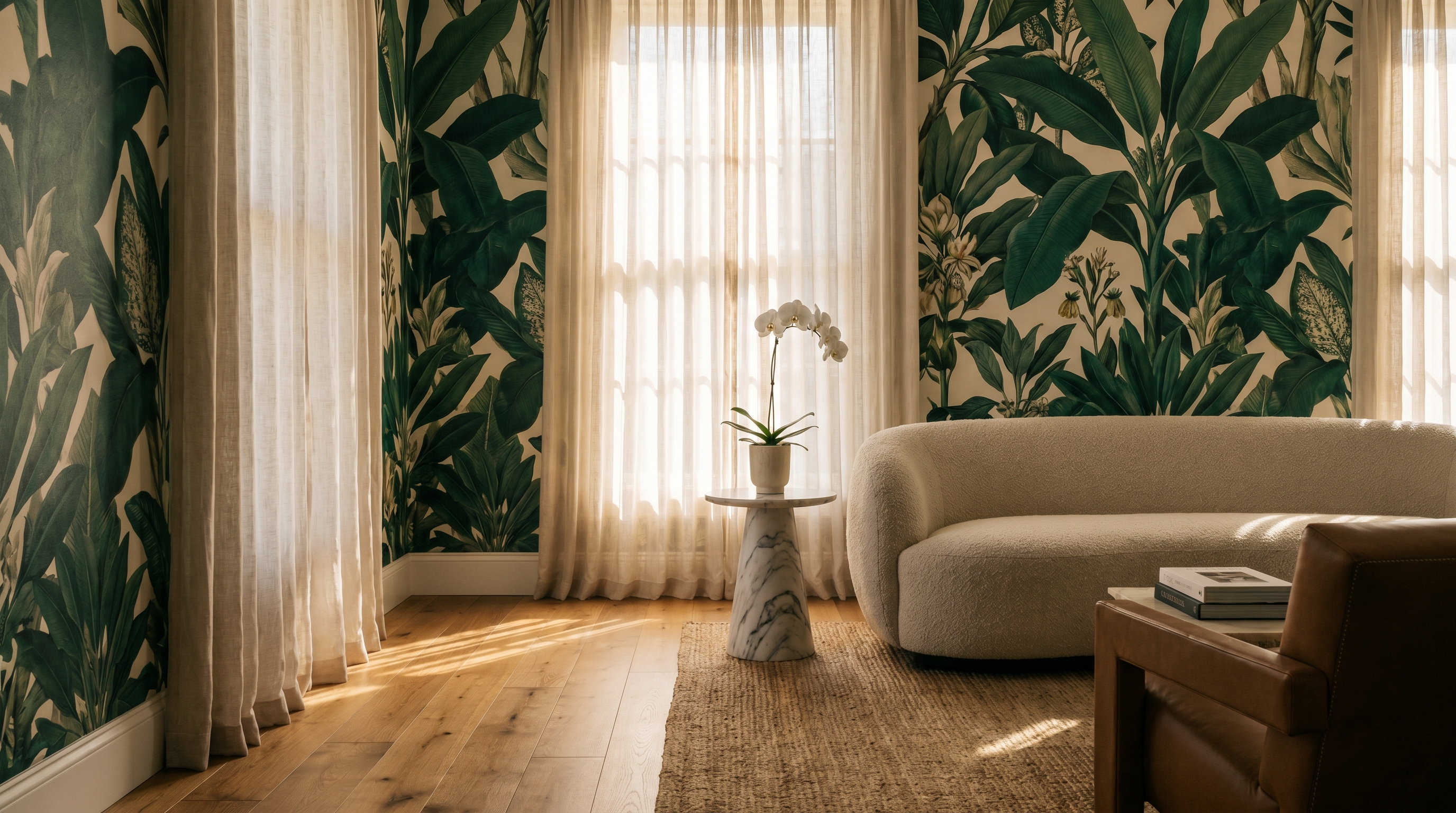
Every wallpaper has a pattern repeat — the vertical distance before the pattern starts again. A plain or textured paper has a repeat of zero. A small geometric might repeat every 9cm. A large botanical mural might repeat every 64cm.
The repeat matters because you need to align it at every join. This creates waste: the larger the repeat, the more paper you lose per drop. A paper with a 64cm repeat in a 2.5m-high room means each strip wastes up to 64cm of paper finding its match.
| Pattern repeat | Waste per drop (2.5m ceiling) |
|---|---|
| None / plain | 0–5cm |
| Up to 15cm | ~10cm |
| 15–30cm | ~20cm |
| 30–64cm | ~40cm |
| 64cm+ | Up to 64cm |
Step 3: Calculate drops per roll
A standard roll is 10m long (some luxury papers are 5m — check the spec). Divide the usable roll length by the cut length per drop.
Cut length per drop = ceiling height + pattern repeat. In our example: 2.5m ceiling + 0.64m repeat = 3.14m per drop. A 10m roll gives us 3 drops (10 ÷ 3.14 = 3.18, rounded down). Don't round up — the fractional drop isn't usable for a full-height strip.
Step 4: Calculate total drops needed
Most wallpaper rolls are 52–53cm wide. Divide your total perimeter by the roll width to get the number of drops: 15.6m ÷ 0.52m = 30 drops.
Step 5: Account for doors and windows
A standard door (0.9m wide) saves approximately 1–2 drops. A standard window (1.2m wide) saves 1–2 drops. However, the strips on either side of a door or window still need to be cut from full drops to maintain pattern alignment, so the saving is modest.
Our rule of thumb: subtract one roll per door, half a roll per window. For the example room with one door and two windows: 30 drops ÷ 3 drops per roll = 10 rolls, minus 1 (door) minus 1 (two windows) = 8 rolls.
Step 6: Add your safety margin
Always order at least 10% extra on plain or small-repeat papers, and 15% on large-repeat papers. This covers installation errors, future repairs, and the inevitable moment you realise you miscounted.
In our example: 8 rolls × 1.15 = 9.2, rounded up to 10 rolls. Order 10.
"The rule I give every client: if you're between a number and the next number up, always go up. The cost of one extra roll is nothing compared to the cost of a mis-matched patch repair."
Quick reference
- Measure total perimeter of walls to be papered
- Note ceiling height and pattern repeat from the product spec
- Cut length = ceiling height + pattern repeat
- Drops per roll = roll length (usually 10m) ÷ cut length (round down)
- Total drops = perimeter ÷ roll width (usually 0.52m)
- Total rolls = total drops ÷ drops per roll
- Subtract: 1 roll per door, 0.5 per window
- Add 10–15% for waste and contingency
- Always round up to the nearest whole roll
Still not sure? Use our free Rolls Calculator — it does all of this automatically in under a minute.
Harriet Cole
Harriet is Murall's editorial director and a former contributing editor at World of Interiors. She has been writing about interior design for fifteen years.
Continue reading

Never miss a story